
Yesterday, in our launch announcement, we introduced the first permissioned onchain lending market collateralized by tokenized real estate equity, built in partnership with @GromaCorp on @yearnfi and @Morpho infrastructure. That post covered what we shipped and the architecture behind it. Last month, we covered ‘why’ we believe asset-backed credit is the market onchain finance is built for.
This follow-up is about the use case we think will define the next chapter of tokenized real estate: rentvesting, a way for renters to turn their monthly rent from an expense, into an investment.
Below we introduce rentvesting - what it is, why it matters, and how the Birch Hill RWA USDC Vault makes it work for the first time.
The Workflow at a Glance
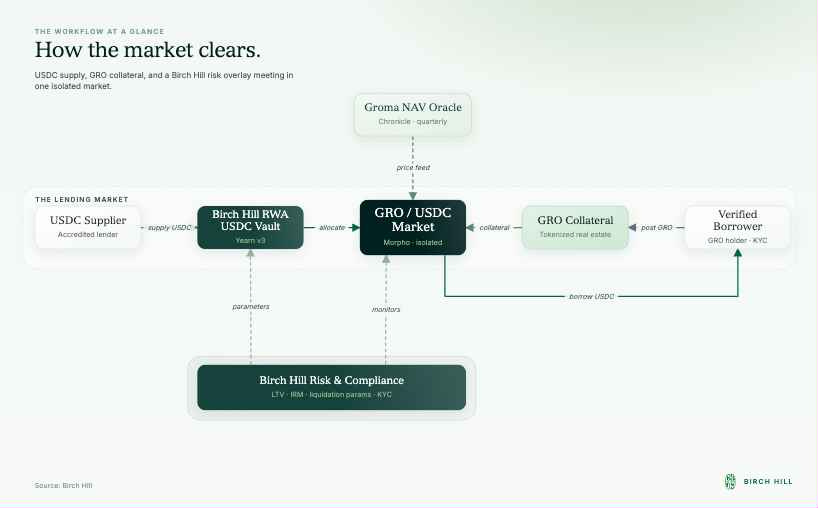
DeFi infrastructure powering security-based lending markets.
Supply side (permissioned at launch). At launch, accredited investors holding USDC can deposit into the Birch Hill RWA USDC Vault and earn yield by supplying liquidity to the Birch Hill Groma market. As mentioned above, participants in this market must complete accredited investor checks in addition to KYC checks, within their profile page on the Birch Hill front-end. Approved accredited investors’ wallets are screened for AML checks before deposits are enabled.
Collateral side (permissioned). GromaCoin holders who KYC post GRO as collateral and borrow USDC against it. Loan-to-value, interest rate model, and liquidation parameters are set by Birch Hill, informed by traditional real estate credit underwriting. Our full underwriting methodology can be found at both our
and our client-login gated monitoring app.
Infrastructure underneath. Birch Hill has deployed Morpho’s institutional-grade lending infrastructure to create our isolated GRO/USDC market. The Birch Hill RWA USDC Vault curates the USDC supply and manages allocation and rebalancing across Birch Hill markets, with Groma being the first market launched. In addition to deploying Morpho contracts, Birch Hill provides the risk engine, compliance layer, and institutional verification layer. Groma provides the asset, the NAV oracle (built by Chronicle with independent review of underlying NAV by Cushman & Wakefield), and quarterly redemption infrastructure.
Through the combination of best-in-class onchain lending infrastructure, RWA-specific oracle architecture, and offchain verification, we have built a market that lets real estate investors gain liquidity on their holdings in a capital efficient, compliance-focused manner.
Introducing Rentvesting
Rentvesting is the renter’s version of a mortgage. In the world we live in, where renting is cheaper than buying a starter home in most major metropolitan areas, many are faced with budget-based decision making preventing them from realizing a lifelong dream: homeownership. However, Groma offers a solution for the modern renter: the flexibility and cost savings of renting, with the upside value accrual of owning a home — inside an existing monthly rent budget, without a down payment, mortgage qualification, or concentration in a single property.
In partnership with the Groma team, Birch Hill is proud to introduce rentvesting to the onchain world.
The Problem
Anyone who has tried to buy a home in a major U.S. city over the last decade has met the same wall. Down payments have outpaced wage growth. Mortgage qualification is harder. Meanwhile, the people who already owned property, or who could afford to leverage into it early, have captured most of the appreciation.
Renters are not just paying rent. They are paying it while watching the asset class they are shut out of compound away from them. The traditional answer we have heard for years, “save up and buy when you can,” no longer works for most renters in Boston, New York, San Francisco, or Miami.
The Reframe
Improving the rent experience has been a market for innovation in the past: rent-to-own agreements with a landlord, Bilt’s credit card rewards program. However, Groma has taken a different direction. Instead of trying to buy the home you live in, you redirect your rent into ownership of a diversified portfolio of homes. Each rent check becomes equity in the GromaREIT, offering ownership of any property value increases. In other words, your assets go to work, making you a real estate investor, while you live in the city you want to live in.
How It Works
Redirect rent into ownership. Each month, the rentvestor sends their rent payment into the program, where it purchases GromaREIT shares in their name. (Their rent still gets paid — see step 2.)
Borrow against shares. The program then lends the rentvestor dollars against those shares, and those dollars pay the rent to the property like normal. The result is an equity stake acquired and rent paid. Groma facilitates this borrowing and, under the current program design, posts additional collateral of its own to support the initial 1:1 borrowing level.
Hold the shares. The rentvestor keeps the GromaREIT shares for as long or as short as they want. They forgo the share’s dividend stream — those dividends stay with Groma to service the cost of financing the covered rent.
Sell when ready. On sale, the share proceeds first repay Groma for the rent it covered on the rentvestor’s behalf; any value above that is the rentvestor’s to keep.
Downside is designed to sit with Groma. If the shares are worth less than the rent Groma covered, the program is structured so Groma absorbs the shortfall with no clawback and no recourse to the renter. If dividends don’t fully cover financing costs, that gap is Groma’s to carry too. The goal is that a renter should never end up worse off than if they had simply paid rent. The program works for Groma by creating an onchain continuous new capital raise as rent becomes both investment and payment, aligns renter and investor incentives for the first time, and scales the Groma ecosystem in terms of people, properties, and capital.
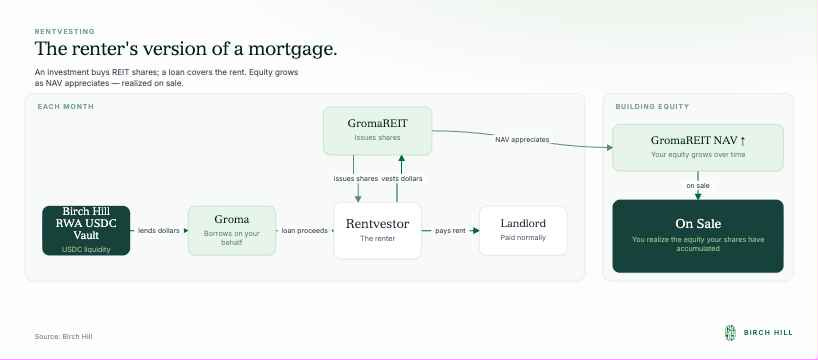
The shape is familiar to anyone who has ever taken a mortgage: convert monthly housing payments into equity in real estate. The difference is there is no down payment, no qualification gate, no concentration in a single property, and a downside-protected payout on exit.
A Worked Example
A renter in Boston pays $2,500/month — $30,000 a year — in rent.
Monthly. The rentvestor’s $2,500 buys $2,500 of GromaREIT shares. Separately, those shares are used as collateral to lend the renter $2,500 from the financing facility to pay their rent. That $2,500 is paid to the property like normal.
After a year. The renter has accumulated $30,000 of GromaREIT shares. $30,000 of capital has been borrowed against those shares (and additional collateral posted by GromaCorp as needed) to cover $30,000 of actual rent.
If GRO appreciates 5%. The accumulated shares are worth roughly $30,806 on sale. Groma is repaid the $30,000 it covered in rent, and the renter keeps about $806 of appreciation. (It’s not $1,500 because while it’s 5% over a year, it’s invested monthly, not all upfront. This distinction matters less in later years.)
If GRO is flat or down. Groma absorbs the shortfall. The renter is whole — no clawback, no recourse. Groma reserves cash against this for further downside protection.
No gate. No mortgage qualification, no 20% down, no single-building bet.
This is what we mean by rentvesting: the renter’s version of a mortgage, made viable because Groma can finance the rent payments at scale.
Where the Vault Comes In
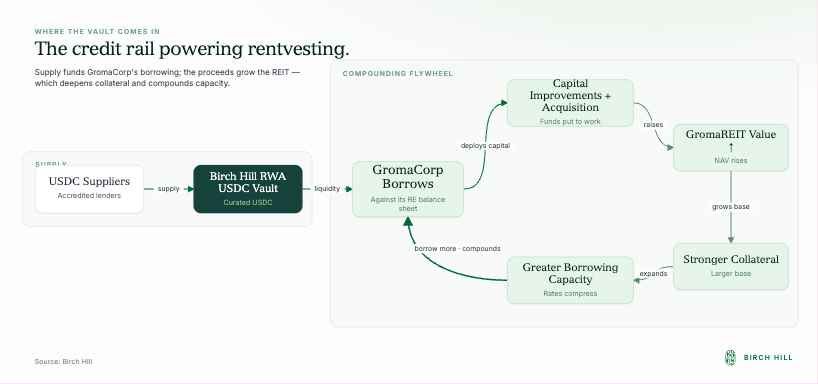
Rentvesting needs a financing pipeline. Our vault acts as that pipeline, with distinct advantages over traditional real estate credit in both our cost of capital and our ability to scale together.
Conventional financing means bespoke negotiations at every stage of growth. Onchain financing offers frictionless access to capital that programmatically scales as Groma’s balance sheet (and borrowing capacity) grows, without ever needing to renegotiate terms from scratch. It also offers a lower-friction path to borrowing against the REIT itself — traditional routes can get you there, but without the programmatic access and transparency the vault provides.
Additionally, we believe that vault rates are structurally advantaged. As yield continues to be a driving force across crypto, stablecoin issuers and holders alike are looking towards diversified, credit-worthy real-world sources. That global, competitive demand offers deep liquidity that is ultimately accretive to Groma, recognized in a cost of capital that traditional financing cannot match.
That is the role of the Birch Hill RWA USDC Vault. GromaCorp borrows USDC against its real estate balance sheet at programmatic, transparent rates. As the partnership scales, supply deepens, and borrow rates compress, expanding Groma’s ability to grow the REIT and its yield.
Our vault is the credit rail powering rentvesting.
Why This Matters
The traditional gating mechanism for real estate participation, homeownership, is breaking. A growing share of the population will rent through their prime earning years not because they want to, but because the math no longer works. This has all kinds of downsides which are becoming more and more visible in renter heavy cities like NYC, Boston, and LA. When more than half of the population is excluded from the system, they have no incentive to reform the system, but rather seek to extract value from it in ways that are proven time-and-time again to be long-term destructive. Even if you already own a home personally, you still want rentvesting to work because cities, systems, work better when everyone can own a part of them.
What’s missing to achieve this is not capital, but modern financial infrastructure. Renters need a way to:
Get diversified, professional real estate exposure without a down payment or a single-property bet
Participate in appreciation with downside protection
Do it inside their existing monthly rent budget
Groma’s rentvesting program provides the solution. The Birch Hill vault gives Groma the financing rail. Together, they make the first viable onchain rentvesting stack possible — with the same compliance, risk management, and reporting infrastructure that institutional credit markets require.
What’s Next
Rentvesting is in internal alpha at Groma now, with a public launch planned for next year. The Birch Hill vault is live now.
If you are a renter who has been priced out of the asset class, a stablecoin holder looking for real-asset-backed yield, or an institution evaluating tokenized real estate credit, reach out to us at info@birchhill.io or directly to the @GromaCorp team at groma.com.
The best version of onchain finance is not a replacement for traditional capital markets. It is a better implementation of them. Rentvesting is one of the clearest examples we’ve seen of what that looks like in practice.
Disclaimer: This post reflects Birch Hill’s internal view as of July 23, 2026. It is for informational purposes only, is not investment, legal, tax, or accounting advice, and does not constitute an offer to sell or a solicitation of an offer to buy any security, token, or investment product. Any such offer will be made only to verified accredited investors through official Birch Hill channels and definitive documentation. Access to the Birch Hill platform is permissioned and subject to identity verification, accredited investor verification, wallet screening, and ongoing monitoring; nothing here should be read as a guarantee of eligibility, access, or terms.
Rentvesting is a program of GromaCorp, not Birch Hill. It is in internal alpha; its structure, terms, and availability are subject to change, and there is no assurance it will launch as described or at all. Birch Hill does not offer, administer, or guarantee the rentvesting program. Any downside protection described is a contractual obligation of GromaCorp, subject to its ability to perform, and is not a guarantee, insurance, or deposit protection. GromaREIT shares are securities subject to their own risks, including real estate market risk, NAV-based valuation, limited redemption windows, and illiquidity. The worked example above is hypothetical and for illustration only; it is simplified, assumes program terms that are not final, and is not a projection or guarantee of results.
Onchain products carry material risks, including smart contract, liquidation, collateral, liquidity, redemption, oracle, and counterparty risk, as well as the risk of total loss. Digital assets and tokenized securities are volatile and may be illiquid. Yields and borrow rates are variable and not guaranteed; statements about relative cost of capital or rate advantages are opinions and forward-looking. Past performance is not indicative of future results.
Statements regarding future plans, features, or products are forward-looking and subject to change. References to third parties, including Morpho, Groma, Yearn, Persona, VerifyInvestor, TRM, Hypernative, Chronicle, and Cushman & Wakefield, are for identification only and do not imply endorsement; Birch Hill is not responsible for their services. Third-party data is sourced from external providers and is current as of the publication date. Regulatory references are not legal advice. Birch Hill is pre-registration as of this date.