
The Birch Hill Groma Ecosystem USDC Vault (bhGROeco) is now live on Base, powered by Morpho.
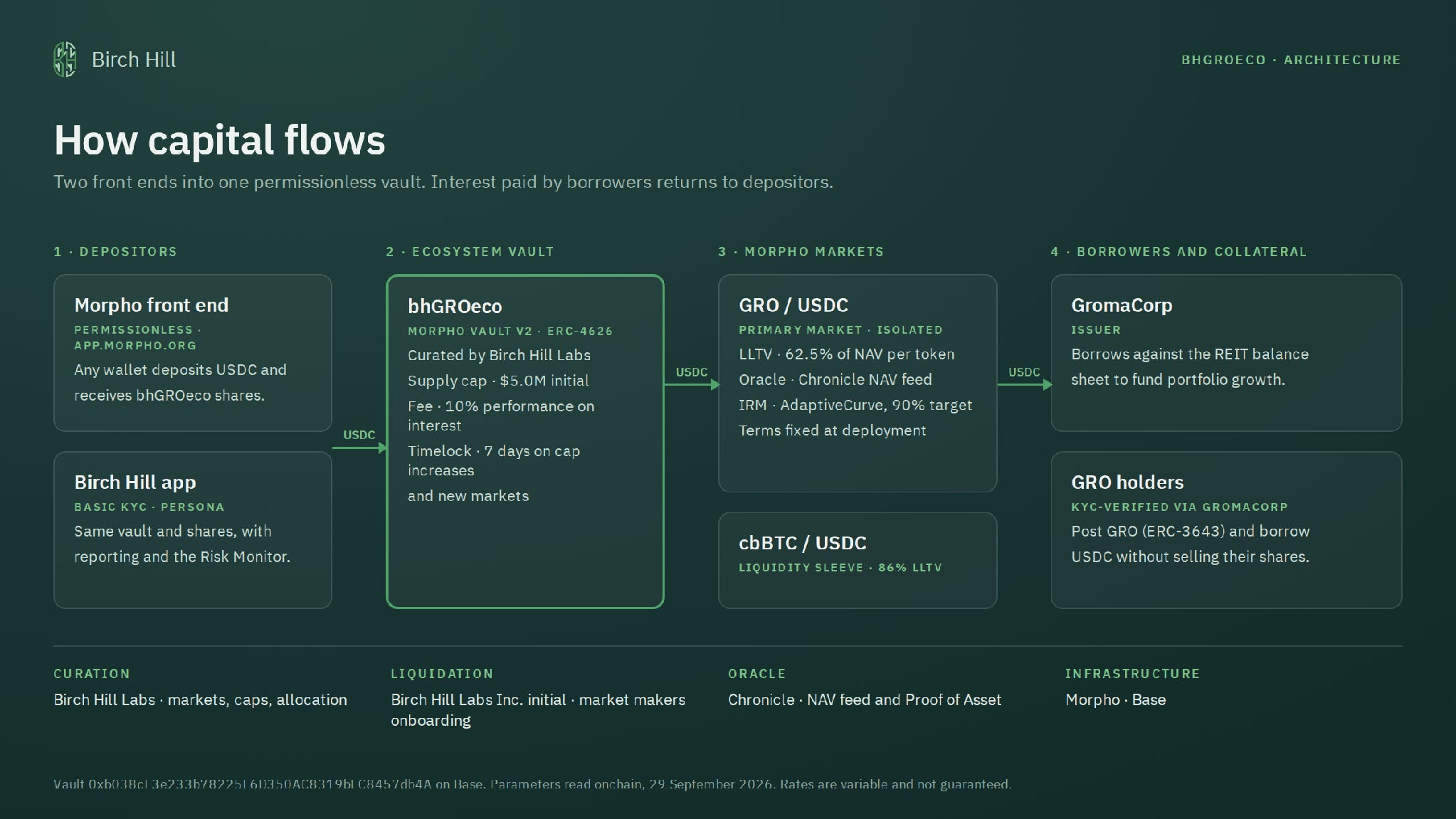
bhGROeco supplies USDC to the isolated GRO | USDC market on Morpho on Base and holds a cbBTC | USDC liquidity sleeve for withdrawals. The collateral in GRO | USDC is GRO, a token that represents a share in GromaREIT, a United States REIT that owns multifamily buildings in Greater Boston and Providence. GromaCorp issues GRO and sponsors and manages the REIT. Birch Hill Labs curates the vault and set the market parameters at deployment.
This is the next step after our first Morpho Vaults and our partnership with Groma, covered in our earlier posts: Introducing Birch Hill vaults on Morpho, Birch Hill’s First Onchain Product Powered by Morpho and Birch Hill partners with Groma.
Why GRO collateral?
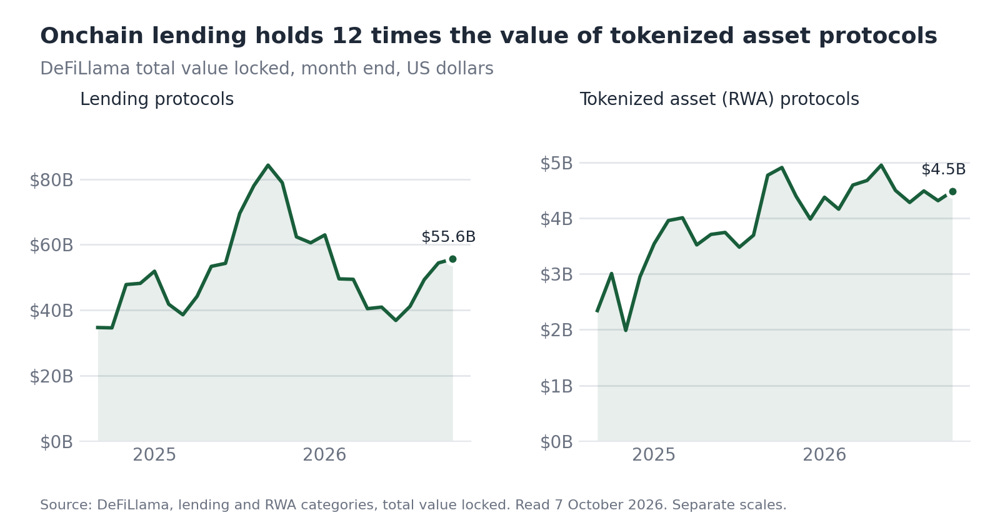
Most USDC lending onchain is secured by digital assets such as bitcoin and ether. Much of that borrowing funds leveraged positions, so both the demand for loans and the value of the collateral move with crypto markets. As of 7 October 2026, DeFiLlama counted $55.6B total value locked in onchain lending protocols and $4.5B in tokenized asset (RWA) protocols.
GRO is backed by a different kind of asset: small to midsize apartment buildings in dense urban core neighborhoods. Currently the majority of properties are located in Boston, MA as well as Providence, RI. Excluding Mosaic, a 146-unit property, the average GromaREIT building has three to four units.
Small multifamily is a large part of US housing, and most of it sits outside institutional portfolios. Buildings with 2 to 19 units represent 39% of all US rental units: 17% of all US rental units are in 2 to 4 unit buildings and 22% in 5 to 19 unit buildings (Harvard Joint Center for Housing Studies, America’s Rental Housing 2026, 2024 data). Individual investors own 58.8% of units in 2 to 4 unit properties, compared with 4.6% in properties of 50 or more units (NMHC, 24 March 2026, from HUD’s 2024 Rental Housing Finance Survey). GromaREIT aggregates 152 of these small buildings, plus the 146-unit Mosaic property, into one balance sheet.
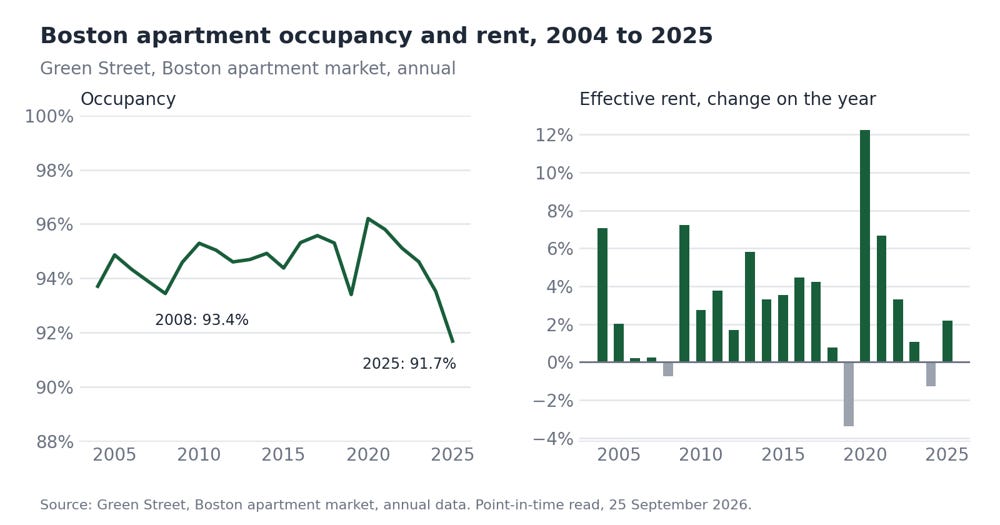
Boston is a supply-constrained market. Green Street data for Boston apartments show occupancy between 91.7% and 96.2% in every year from 2004 to 2025. Effective rent fell in three of those 22 years, by 3.4% at most. New supply was 1.23% of the stock in 2025.
Credit backed by assets like these exists at scale in the United States, but very little of it reaches onchain lenders. Two things hold it back. The first is credit assessment. A lending contract enforces a rate curve, an oracle and a liquidation path. It cannot read a rent roll, mark a property portfolio or size collateral terms to an exit that works. The second is access: many tokenized credit products are offered only outside the United States.
The Market
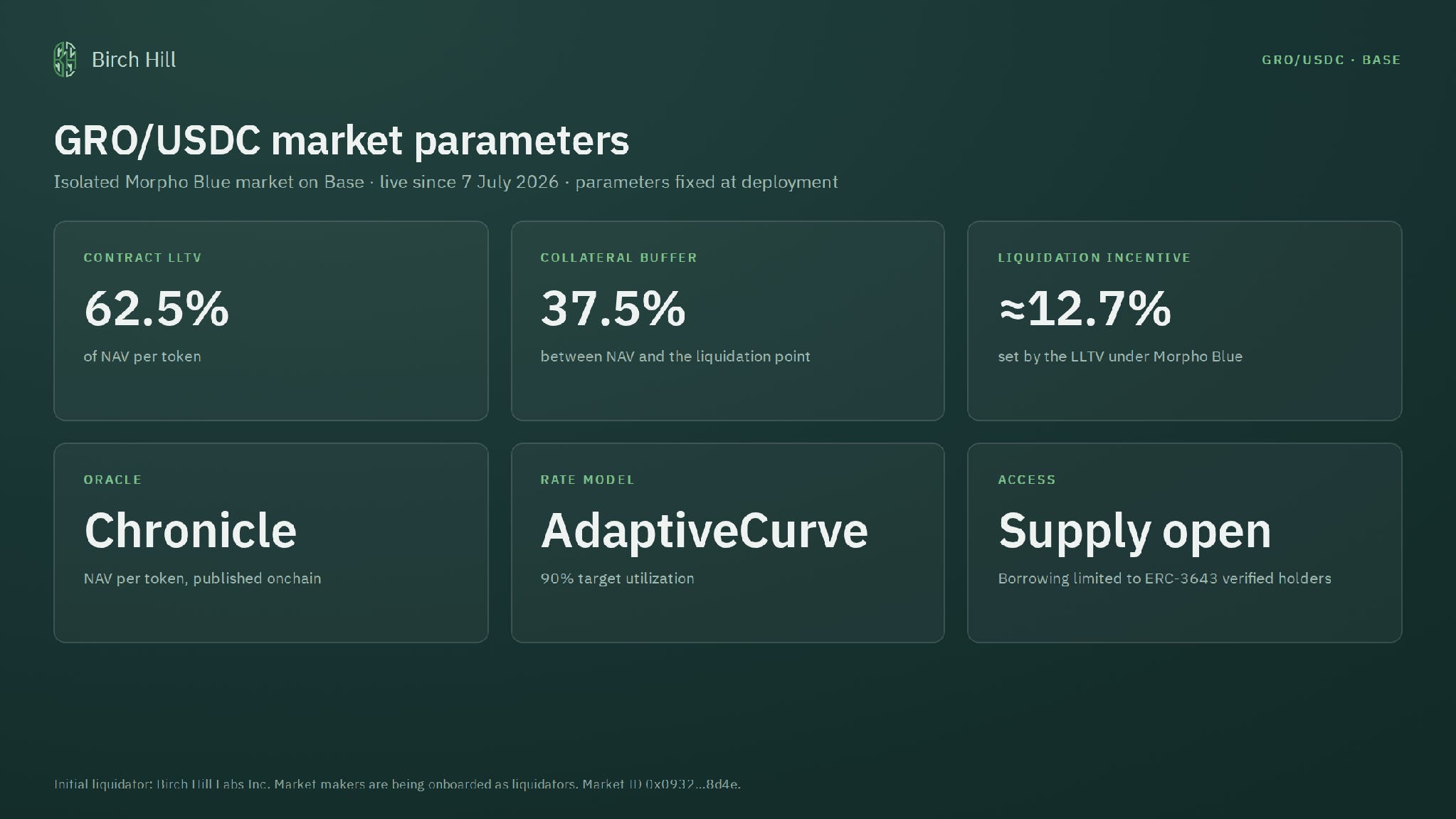
GRO/USDC is an isolated Morpho Blue market on Base, live since 7 July 2026. Morpho Blue markets are immutable after deployment, so no party can change these terms.
bhGROeco is a permissionless Morpho Vault. Supplying to bhGROeco does not require identity verification. Users who access the vault through the Birch Hill app complete a basic identity check. The supply cap on GRO/USDC starts at $5.0M, and any increase waits behind a 7-day onchain timelock.
bhGROeco is one of two ways in. The Birch Hill RWA USDC Vault is a separate, permissioned Flagship Vault for accredited and institutional investors, managed by Birch Hill Digital Asset Management. It allocates USDC across Birch Hill Ecosystem Vaults.
Collateral Overview
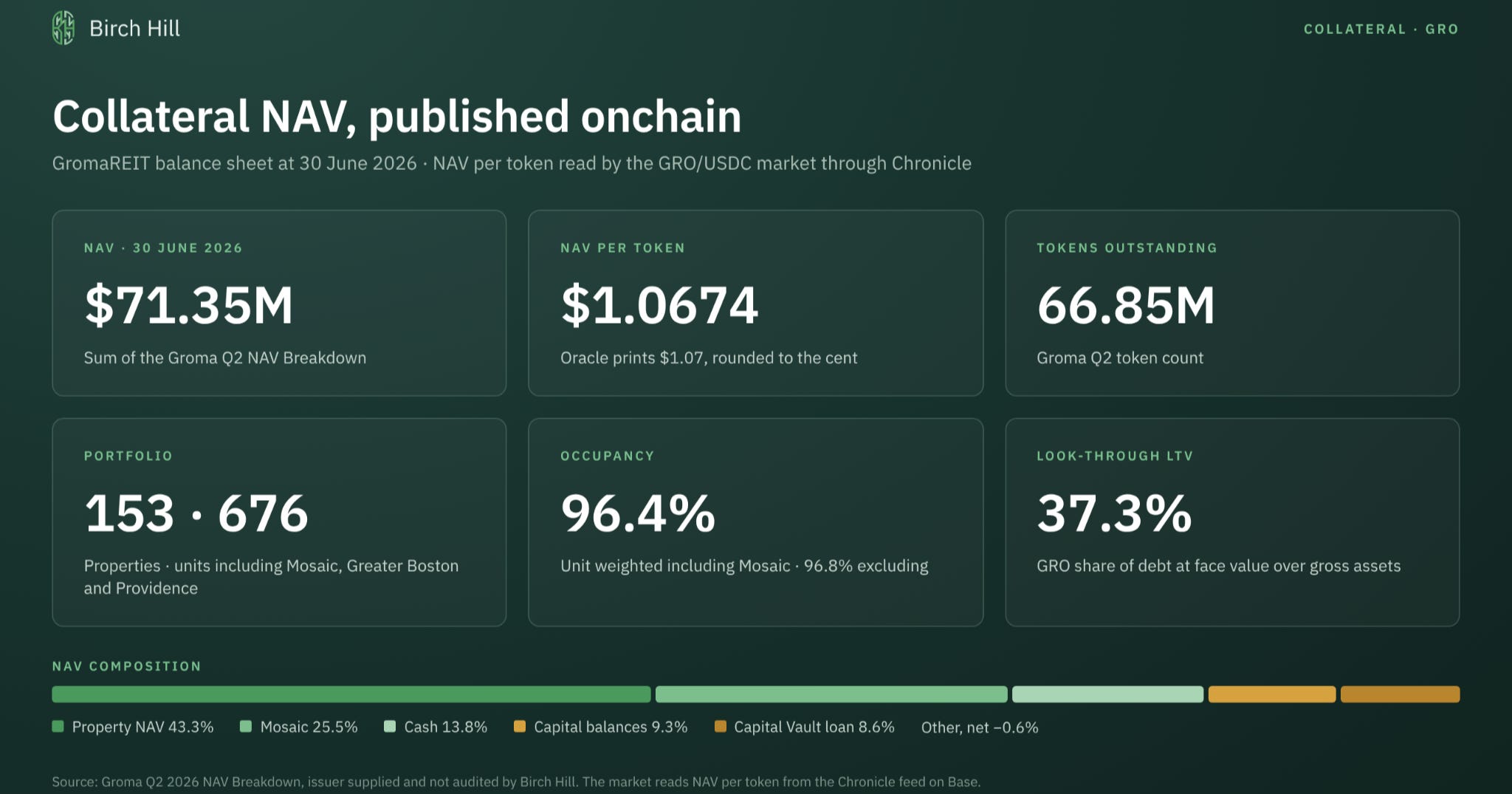
GRO is a security token built on the ERC-3643 standard, which limits holding to wallets that GromaCorp has verified. As of 30 June 2026, GromaREIT held 152 multifamily properties (530 units) in Greater Boston and Providence, Rhode Island, and common and preferred equity in Mosaic, a 146-unit property in Lynn, Massachusetts, equal to 7.3% and 18.2% of NAV respectively. The portfolio was 96.8% occupied, and the REIT reported $71.4M of NAV. Measured through to the properties, with debt at face value, the look-through loan-to-value was 37.3%.
Across the Groma portfolio, property debt is 74% fixed-rate, with a 5.2% weighted average rate (5.1% for the REIT) and a 2032 weighted maturity. On trailing twelve-month NOI earned while each property was owned, over debt weighted by the same holding period, time-weighted interest coverage is 1.20x at the REIT rate and debt yield is 6.1%.
Groma strikes NAV every quarter. Chronicle publishes NAV per token onchain, rounded to the cent, and the market reads that feed directly.
Who borrows
Only verified GRO holders can borrow. GromaCorp borrows against the REIT balance sheet to fund portfolio growth. Other verified holders can borrow USDC against their shares without selling them (see more at A Renter’s Mortgage, Onchain). The market’s interest rate model sets the borrow rate from utilization.
If a position passes the LLTV, a whitelisted liquidator repays the debt and receives the GRO. Birch Hill Labs is the initial liquidator, and market makers are being onboarded as liquidators. Seized GRO can be redeemed at NAV on the same terms as every other holder: up to 5% of start-of-quarter NAV, with further requests queued to quarter end and pro-rated if total requests exceed 10%.
Transparency
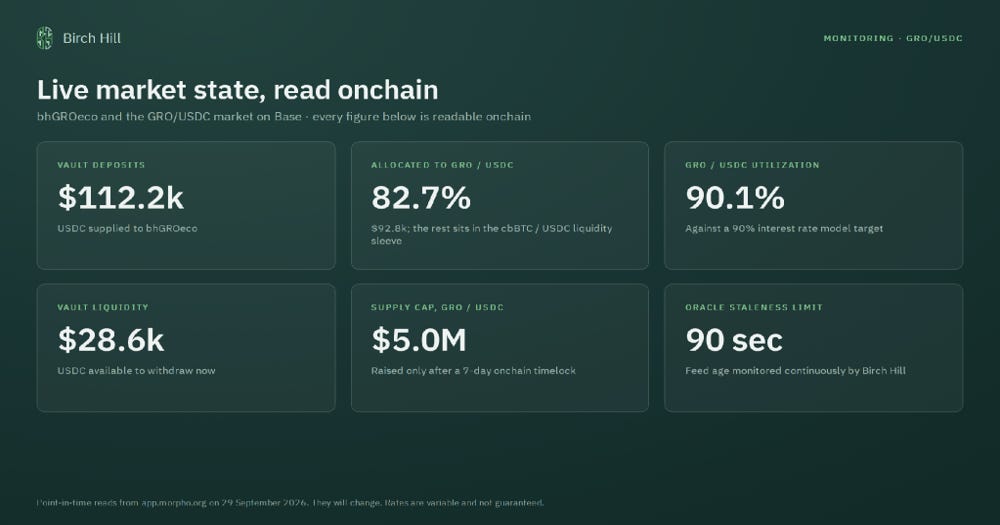
Birch Hill publishes what it holds on the collateral. Each quarter we load Groma’s property tape and publish the figures it supports on the GRO risk page, each with its basis, date and source, and we state which data we do not yet hold. The Birch Hill Risk Monitor shows utilization and rates, every borrower position and its distance to liquidation, and the age of the oracle feed against its 90-second limit.
Risks
Supplying to bhGROeco involves substantial risk, including the loss of the entire deposit.
Smart contract risk. The vault and the market run on smart contracts. A bug or exploit can cause the loss of some or all deposits.
NAV and oracle risk. The market values GRO at NAV per token. Groma sets NAV each quarter and Chronicle publishes it. Birch Hill does not set or audit NAV. If property values fall between quarterly NAVs, or if NAV is wrong or late, the market can lend too much against the collateral.
Liquidation and exit risk. GRO is transfer restricted. A liquidator exits seized GRO by redemption at NAV on the same terms as other holders, subject to the REIT’s quarterly capacity, or by transfer to another verified holder. If recoveries fall short of the debt, depositors share the loss in proportion to their shares.
Liquidity risk. Depositors can withdraw only USDC that is not on loan. Birch Hill cannot force a borrower to repay or a holder to redeem.
Concentration risk. Most of the vault’s lending is against one issuer’s token, GRO.
Conflicts. Birch Hill Labs curates the vault, receives the performance fee and is the initial liquidator.
Disclosure
Access is not available to persons in restricted jurisdictions, and access through the Birch Hill app requires identity verification. The Birch Hill RWA USDC Vault is available only to verified accredited investors. This article is for information only. It is not investment advice, an offer to sell, or a solicitation of an offer to buy any security or financial instrument, and it is not a recommendation of GRO or any REIT. bhGROeco is a vault on the Morpho protocol. Birch Hill Labs curates the vault and does not hold depositor funds. Portfolio figures are as of June 30, 2026, and come from issuer supplied data, which Birch Hill does not audit. Market data from DeFiLlama and Green Street are point in time figures on the dates shown and will change. Deposits are not insured by the FDIC, the SIPC, or any other program. Supplying to a vault involves substantial risk, including the loss of the entire deposit.